
December Update

Hi everyone,
Thanks so much for your patience — I promised myself that I would not work on this update until I finalized our trimester 1 grades. Which reminds me of a point that I’ve been considering a lot in this age of AI: I genuinely enjoy reading my students’ writing (especially when I know it’s theirs). I enjoy printing out their essays and going through it with a pen, underlining great lines, adding positive notes, and identifying areas where they can improve. I don’t want to outsource this work, this joy, to AI. Sure, it takes time, but this is one of the honors and privileges of being an English teacher. What’s the alternative? Students use AI to write the essay, and then we use AI to grade it? A dystopian nightmare, indeed. (And, to be clear, this is exactly what the villains in this larger story want — the masses being “taught” by AI “teachers” while the elite continue learning in largely tech-free spaces.)
For those who have been following this newsletter for a while, you’ll recall that my students’ culminating essays examined what it means to read and write and learn and come of age in this algorithmic and artificial age. Essentially, how does Bradbury’s Fahrenheit 451, our whole-class novel, serve as a warning for today’s readers? What are the parallels between Montag’s world and ours? As I mentioned, I printed out each color-coded essay (students highlighted their thesis in red, topic sentences in green, and textual evidence from Fahrenheit 451 and our Articles of the Week in yellow) and provided “old-school”, handwritten feedback. It took a while, undoubtedly, but students truly appreciated the comments (and the care).
And now we’re in the process of writing our food memoirs (which we’ll finalize before winter break). Again, what an absolute delight to read what our students have to say – about food and about family, about who they are and about where they are from. The restaurants and recipes and rituals.
I could go on . . . but I know we’re all busy, and I want to make sure I’m leaving you with a few concrete resources and strategies that you can bring to your classroom this month (or perhaps save for 2026, which will be here before we know it). Let’s get right to it.
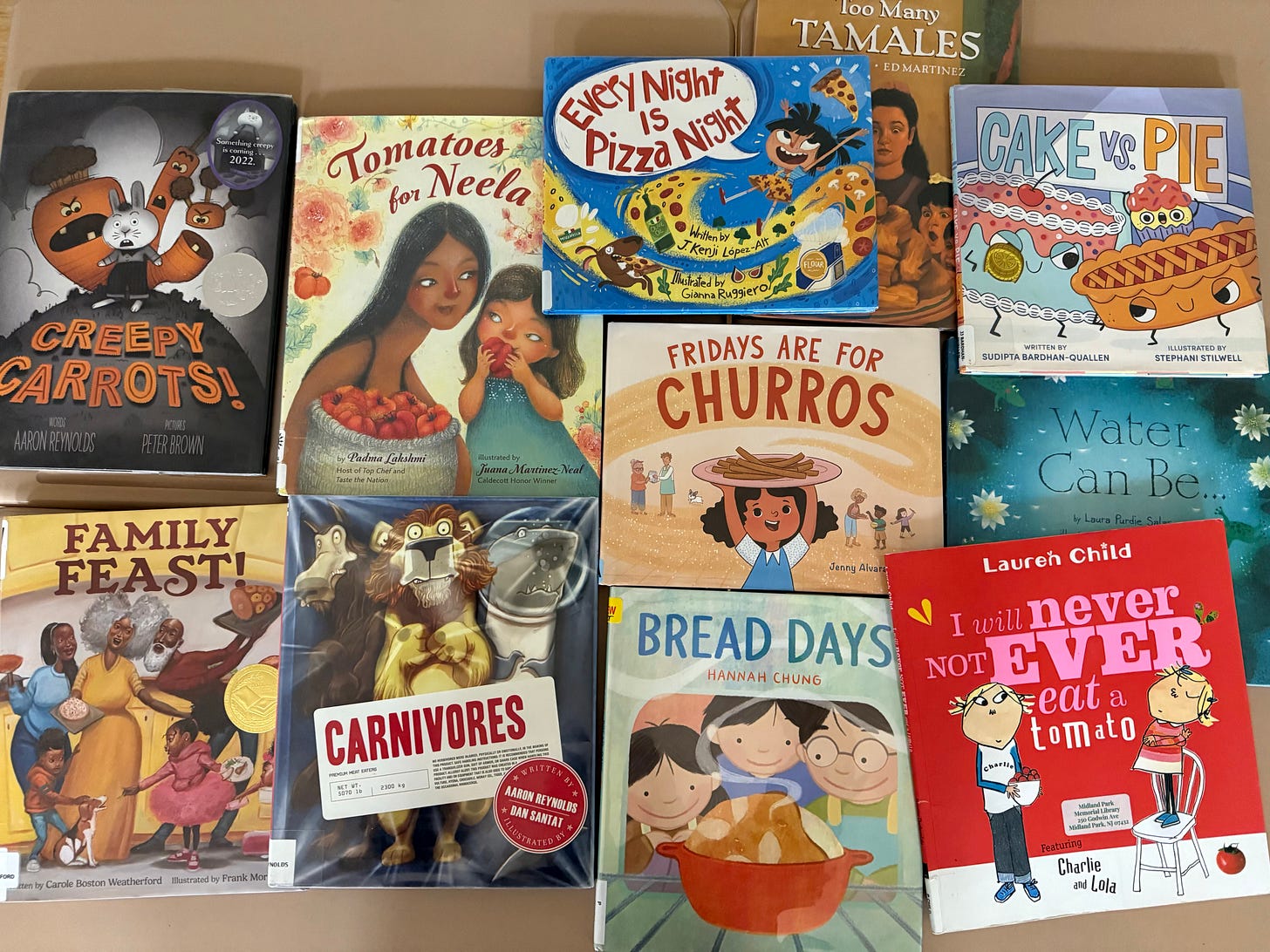
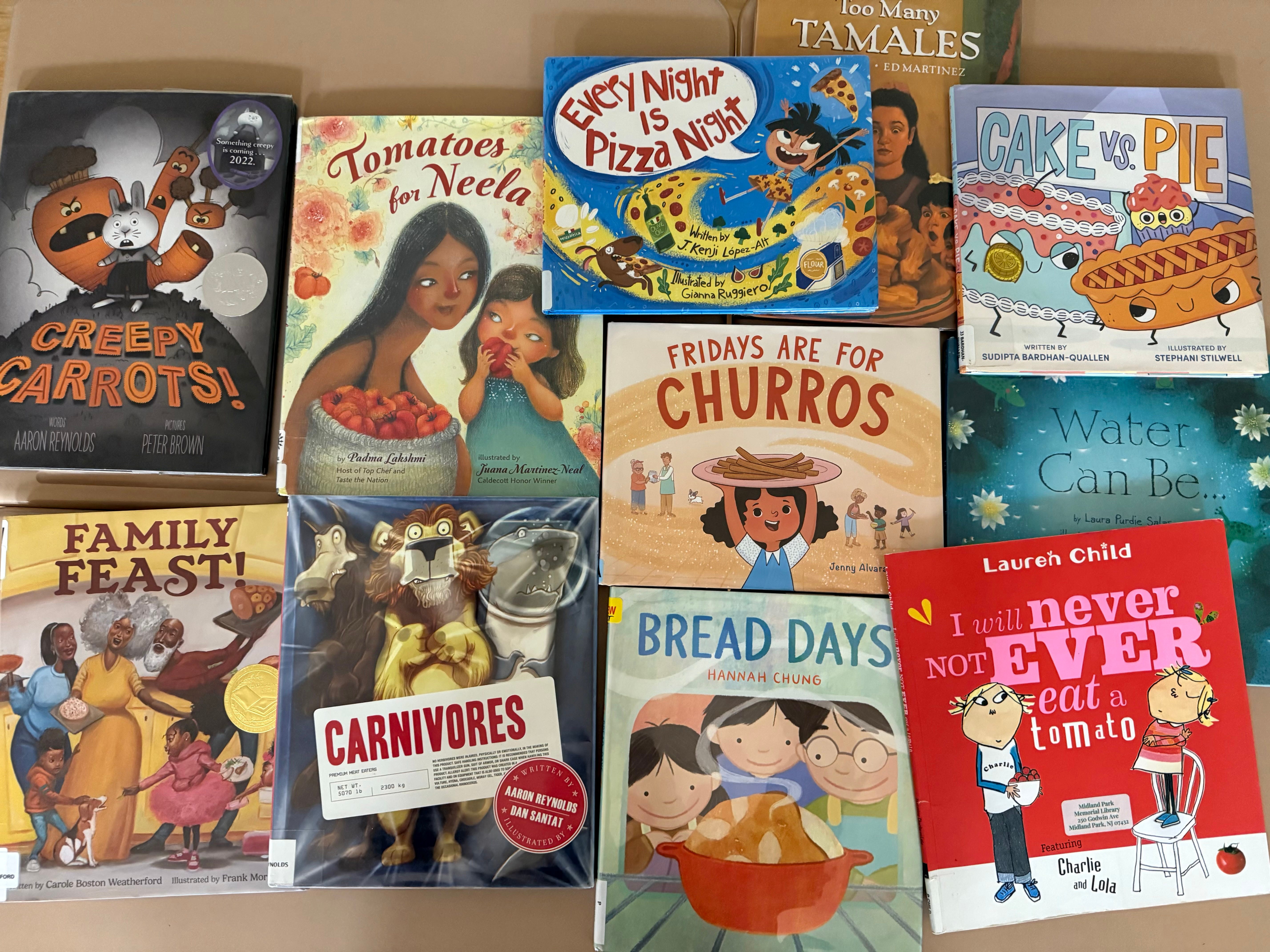
Picture Books + Punctuation: As we all know, there’s never enough time to do or to teach or to “cover” it all, which is why I love prompts and activities that “kill two birds with one stone.” Here’s a recent example. As students began their food memoir brainstorm, I had them read several food-focused picture books (I borrowed a dozen from our local public library and grabbed others, including my son’s favorite Dragons Love Tacos, from our home collection), paying close attention to punctuation. Students then completed this handout, finding and writing down examples from various books.
I also had students take time to come up with a punctuation poem or rap to help their classmates learn how to use the comma, apostrophe, colon, semicolon, hyphen, and dash correctly. They were BRILLIANT. Seriously, some students even performed theirs to the tune of “All I Want for Christmas” or the classic anthem “Crank That.” Highly recommend!
Another example: students paying particular attention to punctuation in our WRAP prompts. (For new readers of this newsletter, following independent reading – of self-selected and whole-class texts – students take time to WRAP – write, reflect, analyze, and participate.) I am super intentional with our WRAP prompts, and here are two recent ones:
Write a CRITIQUE of your current (or recent) read that includes at least four, if not all six, of the following punctuation: comma, apostrophe, colon, semicolon, hyphen, and dash.
Write down a SENTENCE from your current read that uses punctuation in an interesting way, and includes at least one (if not more) of the following: comma, apostrophe, colon, semicolon, hyphen, and dash.
Again, these are authentic, low-stakes opportunities to practice using punctuation, to see how real authors use punctuation, to improve our own writing, to imitate and emulate, to ask questions, to share and discuss with classmates . . . I could go on. Put simply, there is tremendous value in both independent reading and the WRAP time that follows, and my hope is that Just Read It can help you make the case for dedicated Read and WRAP time in your classroom and school. (Please reach out if I can support you and/or your literacy team in any way.)
As you can sense, everything we’re doing in class right now is connected. We’re writing food memoirs (and students will be expected to use a variety of punctuation in their final drafts). We’re having a grammar and vocabulary quiz this Friday, which will include punctuation and our next set of Greek and Latin morphemes. We’re reading independently. And we’re continuing with our Article of the Week.
Speaking of the AoW, this week I had students read and annotate a food essay (options all linked here) and complete this simple but effective graphic organizer. Last week, we looked at the 2025 Words of the Year.
And speaking of the Greek and Latin morphemes, we’ve now covered four sets (16 morphemes per set) through the first trimester, which puts us on track to get through this entire list by June. I know a few people have reached out with questions, so I will try to put together a video explaining how this vocabulary instruction plays out in our classroom.
One more successful activity related to our food memoirs (but also an activity that can work with any text or writing task): I took my food memoir (the one I wrote about Nashville hot chicken) and cut it up, paragraph by paragraph. I had then had students work in pairs to see if they could put it back together in the correct order. (Reach out if you have any questions about this!)
We’ll also practice interviewing each other next week as we prepare for our interview project in January, one of my favorite assignments/projects of the Year. In short, students will conduct a 20-30 minute (if not longer) interview with one person (a family member, family friend, neighbor, coach, teacher, community member, etc.) and then share their recording (either audio or video) in a presentation. Here is the Interview Project Proposal, the first step in the process. I’m happy to share more about this project (why we started it, how it works, lessons learned, etc.) for those who are interested!
I wanted to end this update by sharing some of the books that I’ve read and loved in 2025. One is The Mona Lisa Vanishes, a book that I just read and discussed with my 8th grade Project LIT chapter. (Side note: I am hoping to bring back Project LIT, book lists and all, in the near future; thanks so much for your patience and understanding as I/we figure out what it can and should look like in the years ahead.) A few others (I think I’ll dedicate a separate post to share my complete list) include Coach by Jason Reynolds, Everything We Never Had by Randy Ribay, James by Percival Everett, Station Eleven by Emily St. John Mandel, and My Friends by Fredrik Backman.
REMINDERS: As a reminder, I’d love your help adding to the “core four” (Read and WRAP, AoW, poetry, grammar & vocabulary) documents that serve as the foundational pieces of my classroom. I created this Google form where you can submit your own WRAP prompts, AoW suggestions, and poems.
Here’s a weekly WRAP sequence for the 25-26 school year. A couple of reminders: Over the past few months, I went through my book, Just Read It (use the code HOLIDAY25 for 25% off + free shipping), and attempted to “place” or sequence the WRAP prompts intentionally — one per week for an entire school year. Take a look through the document and let me know if you have any questions, ideas, suggestions, etc. When you get to page 11, you will also find 30+ prompts that students can respond to on a sticky note/index card and that serve as excellent conversation starters. And when you get to page 13, you’ll see that I’m beginning to develop more prompts that combine grammar skills/concepts and literature analysis (two birds, one stone). Please reach out if you’d like to collaborate on this endeavor! For example, shout out to Carriann for setting up this incredible Padlet. Her message: “I started a padlet with all of the prompts you had sent out and included a few of my own. I thought this would be a good place for all of us to start posting ideas for new WRAP prompts. I only did the short ones we’d use for daily questions, not the longer weekly prompts. Anyway, feel free to share this with our collab group so we can have a huge list going!” THANK YOU!
Here’s a potential Article of Week “sequence” for the 25-26 school year, which includes thematic text sets/mini-units (pages 1-2) along with standalone articles and debate topics (page 3). You will also see my “year at-a-glance” on page 4 (more on this shortly). Again, complete this form if you have any questions, comments, suggestions, potential texts and topics, etc.
Here’s a beautiful collection of poems (more than 200!) that we can read and celebrate (and perhaps analyze) with middle and high school students throughout every “season” of a school year. Complete this form with any poems that we should add to the collection.
I’m also updating how I approach grammar (here’s my tentative sequence) and vocabulary (here’s our list of 100+ Greek & Latin morphemes).
Finally, please let me know if your school, district, or organization is planning a JUST READ IT book study or would like for me to deliver a keynote address and/or lead a workshop/PD session in 2026 or 2027. Feel free to share this letter with your school and/or district leaders. You can also contact Authors Unbound (requests@authorsunbound.com) to arrange a speaking engagement and view my speaking profile here. I love connecting with fellow educators and supporting/strengthening your team’s literacy efforts.
Oh, one more thing: I’m super grateful to Beth Hippen of MiddleWeb for this recent review of Just Read It, which “is set up in such a way that the teacher-reader can pick it up this reference guide at any time and put it to work – making it really useful in the classroom. I love the author’s comment that teachers should ‘meet readers where they are, build confidence, and continue to support them on a reading journey that will hopefully last long after they leave our classroom.’”
And with that, wishing you a wonderful holiday season – both in the classroom and in your personal lives. Hope to connect with many of you in 2026! (Which reminds me: please reach out if you’d like to submit an NCTE proposal. I couldn’t make it to Denver, but I’ll be in Philly next November, without question.)
Cheers,
Jarred