
Happy New Year
Recapping our Project LIT Book Club "reveal" and looking ahead to 2024

Happy New Year, everyone!
Lots of us return to the classroom tomorrow, so let’s get right to it!
Our 23-24 Project LIT Book Club selections! You can check out all of our MG and YA titles (along with all of our previous picks) in one place. Thanks again to all of you who participated in our nomination/selection process and social media “reveal” and helped us celebrate 56 incredible books and authors. It was greatly appreciated! (And if you’ve been offline, feel free to head over to Instagram or Threads — @projectLITcomm — for a recap.)
Project LIT graphics. Again, to make things easier for all of us, I’ve tried to put all of our important links and images in one place (so be sure to bookmark).
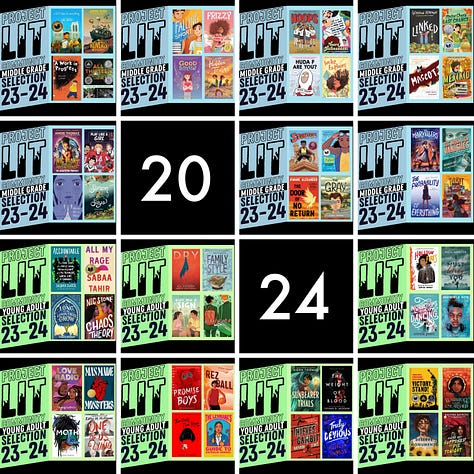
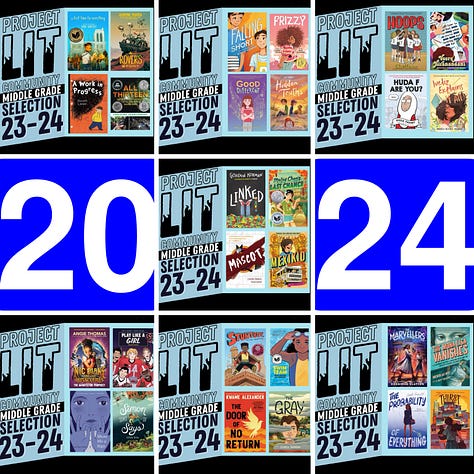
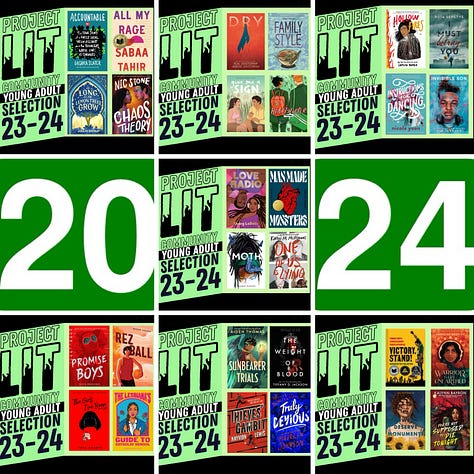
Project LIT Book Club Selections Thanks again to Rebecca A. for creating this fantastic slideshow, featuring all of the YA titles sorted by genre, to help students find their next read. If anyone decides to create a MG version — or any other resources — please pass them along so that I can share with our community!
What should I “do” with the most recent Project LIT book list?! That’s a great question. Here are a few places to start:
Request copies from your local school or public library. (I’ve enjoyed working my way through the list over the past few weeks and cannot wait to dig into many more over the course of the next year.)
Share the list with students & colleagues as we set goals for 2024 and add books to our TBR (To Be Read) lists. (More on this shortly!)
Work with students & colleagues to develop a “2024 Reading Challenge.” (Be sure to share anything you come up with!)
Create a classroom/library “wishlist” and share with friends/family.
See if your school has any room in the budget for a book order.
Meet wih your Project LIT chapter (or survey your students) to identify 3-4 titles to read as a club/class. (I just submitted a local grant application for our schoolwide book club last month…)
Create a beautiful bulletin board display (again, be sure to share and tag us!)
Here’s another question that many of our new subscribers may be asking: What can I do to get started? I’d recommend revisiting my posts from the beginning of the school year. In week 1, for example, I discuss my “10 Things” letter, Best 9 activity, reading surveys, Article of the Week ideas, and more. I think the week 2 newsletter is worth checking out, too. For those ready to jump right into a classroom, school, or community-wide book club, you may find inspiration in our year one slideshow. As always, please don’t hesitate to reach out with questions as you begin your journey!
As an eighth grade English teacher, my focus this week (and this month) is reinvesting my students in our Read and WRAP routine.


In my book JUST READ IT: Unlocking the Magic of Independent Reading in Middle and High School Classrooms (which is now available for pre-order*), I make the case for daily independent reading in all middle and high school classrooms. More specifically, I outline the benefits of establishing our Read and WRAP routine. Daily time to read self-selected books (including but certainly not limited to our Project LIT titles). And daily time to WRAP about our reading. Write. Reflect. Analyze. Participate. Write letters to the authors and six-word summaries. Reflect on our reading growth. Analyze conflict and character and setting and theme. Participate in small-group and whole-class discussions.
*Be sure to use the code CORWIN25 for a 25% discount + free shipping. Corwin also wanted me to remind everyone that “pre-ordering directly from Corwin means customers will receive the book about a month prior to when they'd receive it via Amazon (because of the way Amazon orders their inventory), and with the promo code the price will be lower.” Thanks to everyone who has already pre-ordered and shared with friends and colleagues in your school and district. It means the world to me!
After listening to this podcast episode, I am even more convinced that all of us — students and educators, readers young and old — benefit from 10 to 15 minutes (if not longer) of daily time to Read and WRAP. To get lost in books of our choosing (really good stuff happen in our brains when we stop scrolling) and to engage in meaningful writing, reflection, conversation, and community-building. January is the perfect time to establish (or re-establish) our Read and WRAP routine, and I’d be happy to answer any/all questions you may have as you get started!
Here’s one way I plan to reinvest students in our Read and WRAP routine — a “Benefits of Reading” or “Reasons to Read” brainstorm.
Below is an excerpt from JUST READ IT:
Step 1: In their notebooks, students spend two to three minutes silently brainstorming as many “reasons to read” and “benefits of reading” as they can.
Step 2: Students get into small groups to share their respective lists, adding their partners’ responses to their notebook.
Step 3: Teacher invites students to move around the classroom, continuing to find new partners and add to their lists.
Step 4A: Teacher invites students to return to their seats and review their complete lists. How many reasons do you have? Who wants to share their complete list? What did we learn from the activity?
Step 4B (Optional Extension): For those who want to introduce the research process, here’s an idea: Students, now let’s take out our Chromebooks and see what additional “reading benefits” we can find online. What key words should we include in our search? What do we know about reliable and unreliable sources? Students will then find and share helpful articles/links, ultimately adding to their respective lists.
Step 5: Teacher encourages students to select their favorite (most important?) reason and write it neatly/creatively on an index card to be displayed in the classroom.
Step 6 (Optional Extension): Students can use their notes to create their own “Top Reasons to Read” list and/or infographic. (For example, this is an awesome opportunity to introduce Canva.)
Step 7: Along with their reading list, it’s also a great opportunity for students to create a second listicle (think BuzzFeed list-articles) of their choosing, based on their own interests. A few examples:
•• Top 10 Pieces of Advice for (Teachers, Parents, Athletes, Siblings, Friends, etc.)
•• Top 10 Reasons I Love (Soccer, Gymnastics, Cooking, Taylor Swift, Fall, etc.)
•• Top 10 Reasons to Join (a specific team, club, organization, etc.)
One final note: this activity is super easy to modify. Instead of 10 reasons, we can create “Top 5” lists. We can also extend the assignment by having students write introductory and concluding paragraphs or adding explanations for each of their points. Lots of options here!
Here are a few more activities I’m planning to get to this week:
Students write their 2024 Reading Goal and/or Reading Mindset/Motto on an index card, which we then display in our classroom. (I can expand on this next week if you’re curious!)
Students will participate in a classroom and school library “book tasting” activity with the goal of adding titles to their TBR and selecting their first read of 2024.
And this is a new one for me: Students will develop their own personalized reading challenge for 2024. Let’s expand on this one in the next item…
Helping students create a pesonalized reading challenge for 2024.
I spent a lot of time reviewing the 2024 reading challenges that have been floating around the Internet. Here are a few:
https://www.the52book.club/2024-challenge-guide/
https://bibliolifestyle.com/the-2023-reading-challenge/
https://bookriot.com/read-harder-2024/
https://wereadtweenbooks.com/reading-challenge-for-kids-2024/
https://d15fwz9jg1iq5f.cloudfront.net/wp-content/uploads/2023/12/01215305/Epic-Reads-Reading-Challenge-2024.pdf
I kept coming back to this question: How can we make this work for the readers in our classrooms?! Here’s where I’ve landed — what if each student made their own reading challenge?! For example, some students may decide to create a 2 x 2 grid. For them, four books in 2024 (perhaps across four different genres) will be a massive success. Other students may decide to create a 3 x 3 grid (selecting nine of their favorites from some of the challenges linked above). Or perhaps students may decide to set a goal of 24 in 24 (similar to this one). Again, I’ll be sure to share what we come up with in next week’s update, but please reach out with any questions. I don’t know exactly how this is going to play out, but I do know this — as much as I loved this break (and wish we had a few more days to relax and recharge), I cannot wait to be back in the classroom, reading and writing alongside our incredible young people.
Wishing you and your loved ones a healthy, happy 2024. Thanks for all you do, and, as always, happy reading!
Jarred
After years of following ProjectLIT I have finally decided and put in to action of starting a book club at my school. I work at a high school in Staten Island (for context) and I have my first book club meeting on January 4th. I was hoping I could get any suggestions or guidance on how to format the club, how to go about deciding on what book to read.
I have so many ideas flying around my head (which lead to the procrastination of starting the club) and would love some help grounding some of them! The first meeting is more of an introduction/interest focus. But moving forward I’d like to have a structure to our meetings and try to avoid it feeling like yet another class. Thanks in advance ☺️